
November 2024.
"Either we settle down," she said, "or we break up."
Between us on the table, her latte had gone cold. Double shot. Strange, the details you keep.
Five years together. One sentence, and it was over.
In that moment, all I could feel was she doesn't understand me. It took me a long time to accept the simpler, harder truth: we were chasing different lives. She wasn't wrong. I had just decided to build a startup — for real this time, not as a side experiment. She looked at that decision and saw what it actually meant: years of uncertainty, a person who would never stop chasing the next question. She needed solid ground. I was choosing the opposite.
We were both right. That's the part nobody warns you about. The hardest choices in a founder's life aren't between good and bad. They're between two things that are both true.
I've had almost two years to think about what that choice cost, and what it bought. This is the honest accounting.
Everything I own, I paid for in judgment
Here's what I've learned since that November: the most expensive currency in a founder's life isn't money. It's judgment — knowing what to build, what to quit, what to keep, and what to give up.
Money you can raise. Time you can spend. But judgment you pay for in advance, with years, and you find out later whether you bought the real thing.
My whole career was me paying for it, one installment at a time.
I joined an a16z-backed startup as an engineer and rode it through to exit. That installment bought me the truth about early-stage architecture — what it actually looks like when the whole company depends on it, not what the blog posts say.
Then Bloomberg, building infrastructure as a senior engineer and product lead. That one bought me scale: what happens to systems under real load, and what it costs to fix a decision someone made five years before you arrived.
I quit each of these faster than my resume reviewers liked. Quick to decide, quick to quit — test the idea, measure the ceiling, check whether the returns compound, move. For years I thought this was a character flaw. It was judgment training. I just hadn't gotten the bill yet.
The bill came in November 2024.
The year I bought the wrong thing
Two months before the breakup, I had already left my job. In 2024 I ran the obvious play: turn career experience into income. Career consulting. AI consulting.
Let me be precise about how naive I was. I didn't understand the difference between a product and a service. I had never once thought about moat. Never asked where the ceiling was. Never realized how operations-heavy a service business is until I was buried under it — recruiting, scheduling, delivering, invoicing, all of it me.
It was hard, it didn't scale, and it worked just well enough to hurt: real paying clients, a full business loop closed for the first time — acquire, hire, deliver, get paid. You can read a hundred essays on product versus service and learn less than one year of building the wrong one.
So by that November I was a man with no job, a struggling service business, and a five-year relationship ending over the next thing I was about to do. If you're keeping score of the judgment account: deeply overdrawn.
I went all in anyway.
The sentence I couldn't stop hearing
January 2025. I became cofounder and CTO of a fintech agent startup.
And that's when I started noticing something strange. This was the middle of the AI coding boom — models writing production code, demos everywhere — and yet at every cofounder matching event, every accelerator cohort, every networking room in San Francisco, I kept hearing the same sentence:
"I just need a technical cofounder to build the MVP."
Over and over. Different founders, same sentence.
AI could already write the code. So what were they actually asking for?
The bar moved, and everyone missed it
Here's what actually changed when AI learned to code — and it's not what most people think.
The MVP got cheap, so the MVP stopped being impressive. Investors and users now expect a better product, not a demo. Traction expected. Quality expected. The bar didn't drop when AI arrived. It rose.
And the founding team is shrinking. More founders go solo. Technical founders go solo if they can handle growth. Non-technical founders have more leverage than they've ever had — engineering is no longer the moat, no longer the blocker.
But I kept watching the same two failures repeat, from both sides of the table:
Technical founders ship beautiful products and hit a wall on the only thing that matters — growth. If growth isn't goal number one, you're not building a startup; you're burning investor cash with good engineering.
Non-technical founders vibe-code a working MVP in a weekend — then can't fix the bugs. Can't judge the architecture. Stack up tech debt before their first paying user. Then they hire engineers, and the engineers discover the foundation needs a rebuild — right when users finally show up and the system needs to scale.
For a while I doubted my own read. Maybe solo non-technical founders really can go all the way now — AI codes, they know the business. Then the tech-debt horror stories started arriving. On schedule. A founder would send me a repo that demoed flawlessly; I'd open it and find the whole product balanced on a single synchronous call, a database nobody had indexed, auth bolted on as an afterthought — a month from real traffic and built to buckle. Every one the same story, different logos.
That's when the sentence decoded itself. "I need a technical cofounder" was never about the code. It was about the judgment. They needed someone who knows what the right system looks like — what to build, in what order, and what will break at scale.
The thing I'd been paying for my entire career.
Judgment has a price tag: $3,000–$15,000 a month
There's an existing market for exactly this. It's called a fractional CTO, and it costs $3,000–$15,000 a month. A technical cofounder costs even more: 33–50% of your company, forever.
Pre-funding founders can afford neither. So they get their judgment from the only place left — the AI coding tools themselves. And those tools have a dirty secret: they code brilliantly only when the person instructing them knows what to ask for. Ask a vague question, get a confident, wrong system.
The tools were never the bottleneck. The judgment is.
So the question became unavoidable: can AI deliver the judgment layer — the part of the CTO job that decides what and in what order, not just how — at a price a pre-funding founder can actually pay?
I didn't write a line of product code to find out. I validated by being the product: paid technical advisor, paid consultant, paid AI-building teacher. Real clients across all three. A year of doing the CTO job manually taught me the map I needed — which parts of technical judgment automate well today, which parts still need a human, and how that line keeps moving as the models get better.
I've been the early startup engineer, the big-tech infra lead, the CTO, the consultant, and the teacher. The gap sat at the intersection of all five. So I built for it.
Jaguar AI: the judgment layer
Jaguar AI is your technical cofounder and CTO — equity-free. It's the judgment layer for engineering: it helps you ship the right architecture before you write a line of code.
What it does today: maps your business logic into a system design. Gives you a design template matched to your industry — fintech, healthcare, agentic AI — with compliance baked in. Highlights risks before they become rewrites. Sequences your build so you ship in the right order. Hands you paste-ready prompts so your AI coding tools finally get instructions worth executing.
Connect your Git, and it keeps watching: as your codebase evolves, it flags design risks while they're still cheap to fix.
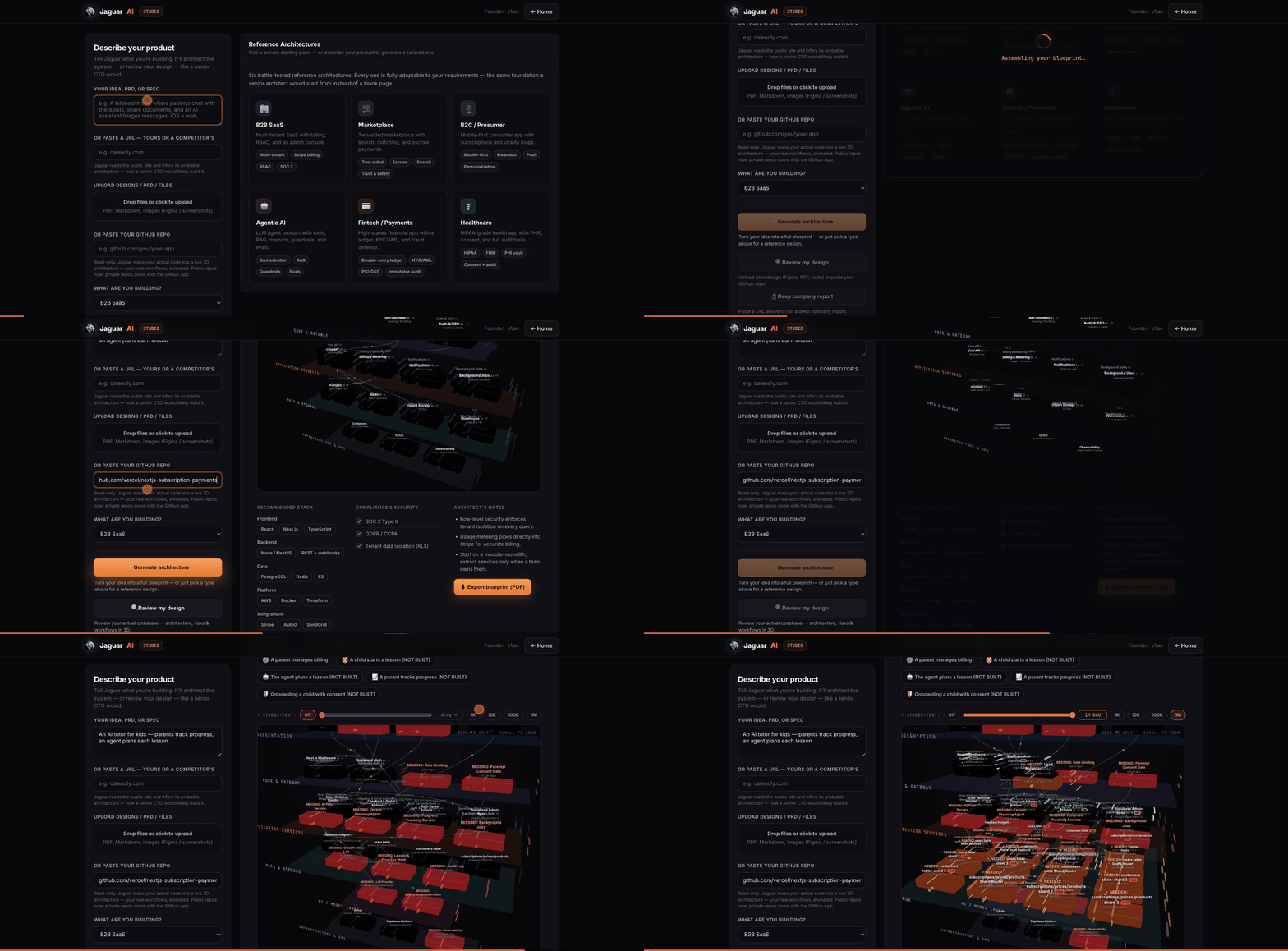
The founding team of the future: you + an AI CTO + AI coding tools.
Only one of them needs equity — and it's yours to keep.
The honest version of the pitch
I won't tell you AI replaces every technical cofounder today. It doesn't — yet. The human line still exists, and I've mapped it carefully, because I spent a year working both sides of it with paying clients.
But that line moves in one direction only. And every month, the founders who understand this ship faster, spend less, and keep more of their company.
As for me — she needed to settle down, and the truth is, I finally have. Not into a house or a plan, but into the one problem my whole life was accidentally preparing me for. The startup, the exit, Bloomberg, the failed consulting year, the CTO seat: ten years of paying for judgment, one expensive installment at a time.
Jaguar AI is where it all compounds. This one, I'm not quitting.